
She Thought She Needed More Revenue. The Real Problem Was Where It Was Going.
- First Forge

- May 1
- 3 min read
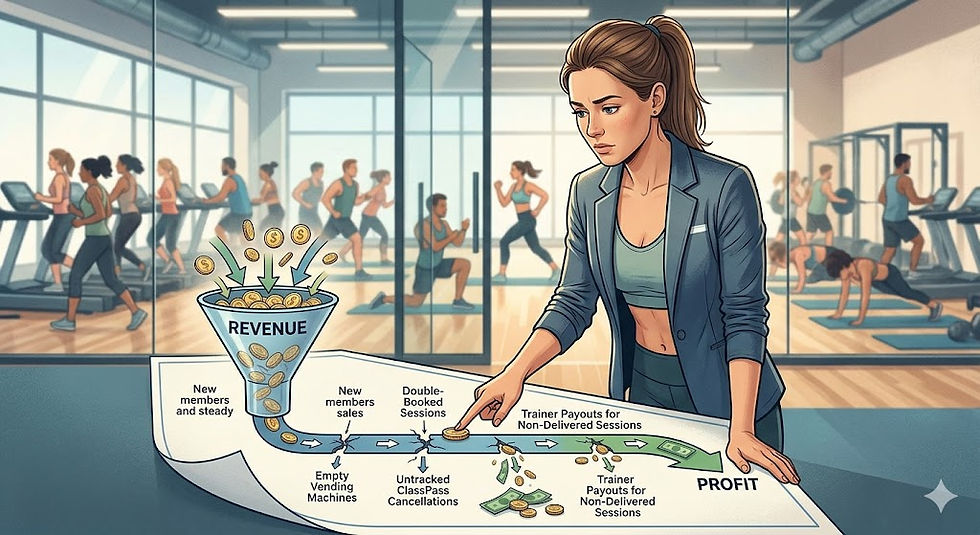
Selina runs a chain of franchised fitness outlets in Singapore.
Reputable brand.
Strong franchise support.
From the outside, the business looked healthy: classes were filled, new members were coming in every month, and revenue was steady.
But like many founders, she felt the pressure.
Margins weren't where they should be. The effort required to sustain the business felt too high. Growth felt harder than it should.
Her conclusion was straightforward:
We need more revenue.
So the focus became familiar:
More promotions
More campaigns with micro-influencers
More ways to bring people in
On the surface, it made sense—if revenue wasn't enough, you increase it.
That's what most founders do.
The Assumption That Goes Unquestioned
There is a quiet assumption many businesses operate on:
If profits are under pressure, revenue must be the issue.
So they push harder on sales.
More leads.
More discounts.
More activity.
But this assumption is often wrong.
Because what looks like a growth problem is frequently a leakage problem.
And leakages don't announce themselves.
They don't show up as dramatic failures.
They show up as friction—as inefficiency, as "just part of operations."
What Our Diagnostic Revealed
Selina agreed to run a diagnostic—not because she believed something was broken, but to prove and validate her thinking.
What surfaced had nothing to do with revenue generation.
Instead, we found a series of small, operational breakdowns:
Vending machines not being restocked consistently
Water coolers running empty during peak periods
Studios were not cleaned or disinfected timely between classes
Trainers double-booking personal training sessions
Last-minute cancellations not tracked, especially through platforms like Classpass
Trainers still being paid for sessions that never took place
Individually, none of these issues seemed critical.
They were easy to dismiss: a missed restock here. A scheduling issue there. A cancellation that slipped through.
But taken together, they formed a pattern.
The Cost of "Small" Problems
These weren't isolated incidents—they were recurring.
Which meant they were cumulative.
Every
Missed vending restock = lost revenue opportunity
Double-booking or unclean studio = compromised service and client dissatisfaction
Untracked cancellations = direct cost with zero return
Trainer payouts for non-delivered sessions = pure leakage
No single issue would trigger alarm.
But collectively, they were draining thousands every month.
Quietly. Consistently.
And without ever being labelled as "the problem."
Why This Matters More Than Revenue
This part is going to be brutal and uncomfortable:
You can grow revenue and still remain inefficient.
In fact, many businesses do— they scale activity without fixing underlying structure.
Which means, paradoxically,
More clients → more operational drain
More volume → more leakage points
More effort → diminishing returns
So even as revenue increases, the business doesn't feel easier.
It feels heavier. More demanding. More dependent on constant monitoring and intervention.
The Real Issue Was Structural, Not Commercial
Selina didn't have a revenue problem.
She had a structural clarity problem:
Vendor responsibilities weren't tightly managed
Scheduling discipline wasn't enforced
Cancellation and attendance tracking lacked integrity
Cost accountability was blurred across outlets
These weren't "people" or "technology" problems.
They are structural gaps.
And when structure is unclear, standards drift, accountability weakens, and leakages multiply.
Why Founders Miss This
Many founders normalise these issues because they appear small.
Because they happen gradually, not dramatically.
Because the business still runs.
And when something feels off, the instinct is to push for more growth.
More sales feels like progress, but it often masks the real issue.
Stop Growing Into Inefficiency
Before pushing for more revenue, there is a more important question to ask:
“Where is the money already being lost?”
Because plugging leakages:
Improves margins immediately
Reduces operational strain
Increases the effectiveness of existing revenue
Growth becomes meaningful only when the system can retain what it generates.
A Better Starting Point
Selina didn’t need more customers.
She needed to stop losing value from the ones she already had.
Most businesses don’t fail because they can’t grow. They struggle because they growon top of inefficiencies they never addressed.
If
your business feels like it’s working harder than it should
margins don’t reflect the effort being put in
you find yourself stepping in more often than you’d like
The issue may not be growth.
It may be structure.
And until that’s addressed, more revenue will only amplify what’s already broken.
If this sounds familiar...
Your business may already be leaking. It's time to find out where to plug the gaps.
Run the free diagnostic: www.thefirstforge.com/diagnostic
Or speak to us directly:
+65 8743 4540 (Whatsapp)

